You sit through a two-hour meeting, a long train ride or a film, and when you finally stand up, your knees protest. The first few steps feel stiff, creaky and a little awkward, and then things loosen up as you walk. It is easy to shrug this off as “age” or “just sitting too long,” but knee stiffness after sitting is a useful signal from your joints, and in many cases it can be improved.
In this guide we explain why it happens, what is normal and what is not, simple things that help, and when it is time to get your knees assessed.
Why Do Knees Get Stiff After Sitting?
1. Your joints are designed to move
The cartilage that cushions your knee has no direct blood supply. It depends on movement to pump joint fluid in and out, which brings in nutrients and clears waste. When your knee stays bent and still for a long time, that “pumping” stops. The joint fluid becomes less slippery and the tissues feel tight until you start moving again. Clinicians sometimes call this gelling: the knee feels stiff at first and then eases within a few minutes.
2. Muscles and tendons tighten in a bent position
Sitting keeps your knees bent at roughly 90 degrees. Over hours, the hamstrings, calf muscles and the tissues around the kneecap adapt to that shortened position. When you stand, they have to lengthen again, which is why the first few steps feel tight or “locked.”
3. The kneecap is under more pressure
When the knee is bent, the kneecap presses more firmly against the thigh bone. If the thigh muscles are weak or the kneecap does not glide smoothly, the pressure builds up and you feel an ache at the front of the knee. Many people notice this after sitting through a film or a long flight, which is why it is sometimes called the “moviegoer’s knee.” It often overlaps with knee pain that gets worse on stairs, squatting or standing up from a low seat.
4. Early joint wear (osteoarthritis)
Stiffness after rest is one of the earliest signs of knee osteoarthritis. The joint surfaces become rougher and the tissues around the joint grow more sensitive, so the knee takes longer to “warm up.” Osteoarthritis is common and very manageable. Our arthritis physiotherapy programme focuses on keeping the joint moving, building strength around it and reducing flare-ups.
5. Weak thigh and hip muscles
The quadriceps and hip muscles share the load of standing, climbing and walking. When they are weak, the knee joint takes on more stress, and stiffness and soreness show up more easily after any period of rest. This is closely linked to the issues described in our article on muscle imbalance and how physiotherapists assess it.
6. Previous injury or overuse
An old ligament, meniscus or cartilage injury, or repeated overuse from running, cycling or the gym, can leave the knee more reactive to inactivity. If your knee also swells or feels warm, read swollen knee without an injury: what could be causing it? And if the pain sits on the inside of the joint, see inner knee pain: common causes and physiotherapy treatment.
How Long Should the Stiffness Last?
The length of stiffness is a helpful clue:
- A few seconds to a few minutes: common and often related to muscle tightness, deconditioning or mild joint wear.
- Up to 30 minutes: typical of osteoarthritis and worth having assessed.
- More than 30 to 60 minutes, especially in the morning, with swelling in several joints: this pattern can point to an inflammatory condition and should be checked by a doctor.
These are general guides, not a diagnosis. If your stiffness is getting longer, more frequent or more painful, it is better to find out why than to wait.
Who Is More Likely to Get Stiff Knees After Sitting?
- Desk workers and commuters: long hours of sitting are the most common trigger. Our tips on commuting in Mumbai and long car rides apply to knees too.
- People over 40: cartilage changes become more common with age, although stiffness is not inevitable.
- Runners, gym-goers and cyclists: repeated loading can irritate the knee, especially after a hard session followed by sitting.
- People with a history of knee injury or surgery: scar tissue and altered movement patterns can make the knee more sensitive.
- Older adults: reduced daily movement makes stiffness more noticeable. Our elderly home physiotherapy service brings care to your doorstep.
What Helps Knee Stiffness After Sitting?
Move little and often
The simplest fix is to avoid staying in one position for too long. Stand up, walk to the water cooler or do a few gentle knee bends every 30 to 45 minutes. Even one minute of movement keeps joint fluid circulating.
Straighten your legs from time to time
If you sit with your knees tightly bent under a chair, change position often. Stretch your legs out in front of you, or use a footrest or a lower desk setup so your knees are not locked at a sharp angle. A physiotherapist-led ergonomic assessment can fix chair height, desk position and sitting habits.
Warm up before you walk
After sitting, take a moment before you set off: a few gentle knee bends, heel raises or marching on the spot get the joint ready.
Try simple home exercises
These are general ideas for mild stiffness. Stop if any exercise causes sharp pain, swelling or giving way.
- Seated knee extensions: straighten one knee slowly, hold for 3 seconds, then lower. Repeat 10 times on each side.
- Heel slides: lying on your back, slide your heel towards your buttock and back again, 10 to 15 times.
- Sit-to-stand: stand up from a chair and sit down slowly with control, 8 to 10 repetitions.
- Calf and hamstring stretches: hold each for 20 to 30 seconds, 2 to 3 times.
- Straight-leg raises: tighten the thigh and lift the leg a short distance, 10 repetitions.
Strengthen the muscles that support the knee
Strong quadriceps, glutes and calves take pressure off the joint. A structured strength and conditioning plan progresses these exercises safely, especially if you have joint wear or a past injury.
Keep a healthy body weight and stay active
Every extra kilogram adds load to the knee with each step. Low-impact activity such as walking, cycling and swimming keeps the joint nourished without overloading it.
Use heat for stiffness
A warm pack or a warm shower before activity can ease stiffness. If your knee is swollen, hot or newly painful, avoid heat and get it assessed.
How Physiotherapy Can Help
If your stiffness is frequent, getting worse or limiting what you do, physiotherapy treats the cause, not just the symptom. At Worli Physiotherapy, your plan may include:
- A detailed assessment. We check knee movement, strength, kneecap tracking, hip and ankle function, and how you walk, squat and stand up. A biomechanical assessment shows whether the real problem sits in the knee or in how the whole leg moves.
- Hands-on treatment. Manual therapy and joint mobilisation ease stiffness and pain so you can move more freely. Our knee pain physiotherapy programme is built around this.
- A personalised exercise programme. Targeted mobility, strengthening and balance work for your knee, progressed step by step.
- Daily habit changes. Practical advice on sitting, stairs, footwear and activity pacing, so the improvement lasts.
- Measured progress. We track more than pain: range of motion, strength and function. Read how in how physiotherapists measure recovery beyond pain scores.
If you have been told you may need a knee replacement, or you have already had one, our knee replacement rehabilitation programme guides you from first steps to full function. For people who find it difficult to travel, home visit physiotherapy in Worli is available.
When to See a Doctor or Physiotherapist Soon?
Get your knee checked promptly if you notice any of the following:
- Stiffness that lasts longer than 30 to 60 minutes, or that is getting steadily worse
- A knee that is swollen, red, hot to touch or very tender
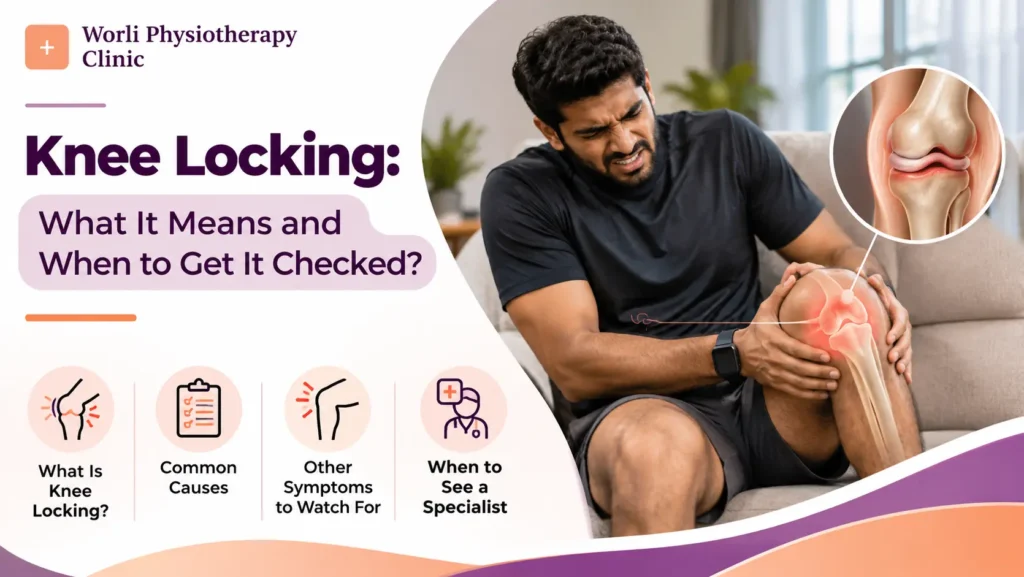
- Locking, catching or the knee giving way
- Pain at night or at rest that does not ease
- Difficulty putting weight on the leg after a fall or twist
- Fever together with a painful, swollen joint
- Swelling, pain or warmth in one calf, especially after a long journey, which needs urgent medical attention
Conclusion
If knee stiffness after sitting is becoming a regular part of your day, you do not have to put up with it. A proper assessment will tell you what is behind it and what to do about it. Book an appointment with Worli Physiotherapy, or contact us to speak with our team. You can also read what to expect at your first visit.